

Many early-career professionals wait for a performance review to learn how they are doing. By then it is late. Asking for feedback regularly shows initiative, and it gives you time to fix small issues before they become big ones.
Why general questions fail
“Do you have any feedback for me?” usually gets “You are doing fine.” Managers are busy and may not want to seem negative. Specific questions get specific answers.
Better questions to ask
- “What is one thing I could do differently on the next project?”
- “In the presentation yesterday, what would have made it clearer for the audience?”
- “What does great work look like in this role, and where am I relative to that?”
- “Is there anything you wish I would do more of, or less of?”
When to ask
- Right after a specific piece of work, while it is fresh
- In a regular one-on-one, if you have them
- After a project ends, as a short review
- Before a formal review, to avoid surprises
A script you can use
Hi Alex, I would like to keep improving. Could we take 15 minutes this week for you to share what is going well and one or two things I should work on? I will bring two examples from recent work.
How to respond to what you hear
- Listen first. Do not defend or explain right away.
- Ask for an example: “Can you point to a time when that happened?”
- Repeat it back: “So the main point is to share updates earlier. Is that right?”
- Say thank you. It makes people more willing to be honest next time.
Follow up
Within a day, send a short note: what you heard, what you will change, and when you will check in again. Then actually make the change and mention it. This closes the loop and builds trust.
If the feedback is vague or unfair
Ask what a better outcome would look like. If you disagree, wait until you have had time to think, then say, “I want to understand this better. Here is my view; can we talk about the difference?” Stay curious, not defensive.
Why asking for feedback matters
Most managers notice more about your work than they say out loud. They are busy, and giving honest feedback takes effort. When you ask, you make it easy, and you show that you want to grow. People who ask for feedback tend to improve faster, avoid small problems turning into big ones and build trust with their managers.
A simple four-step process
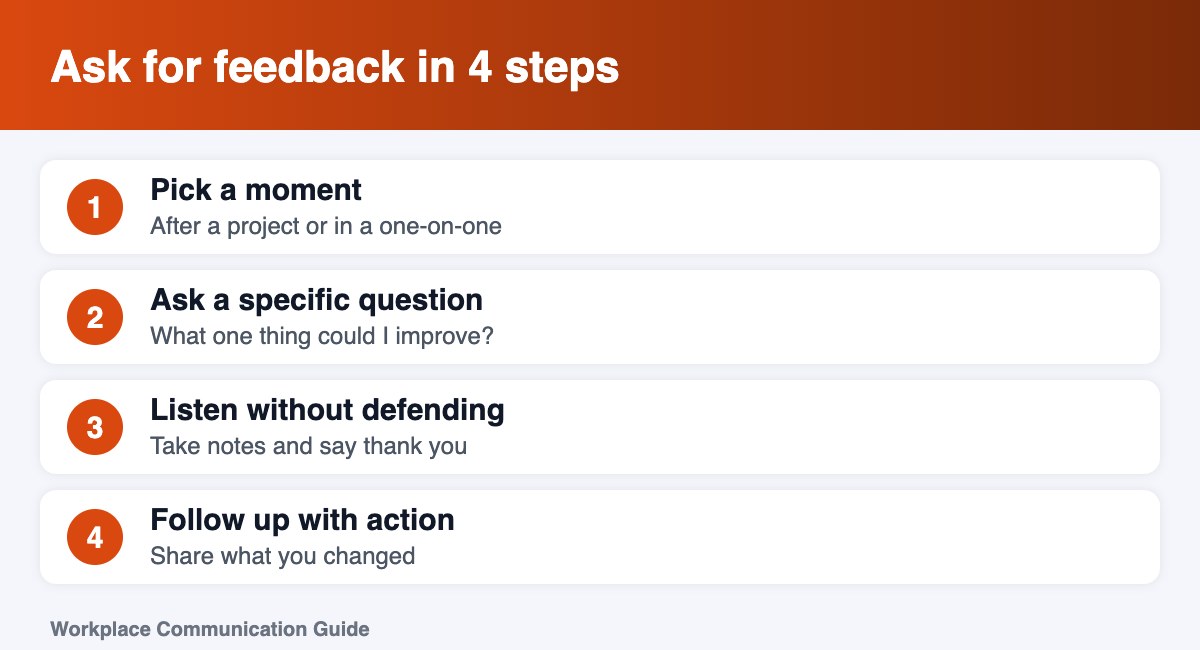
1. Pick the right moment
Ask after a project, a presentation or at the end of a regular one-on-one. Avoid the busiest moments, like right before a deadline or at the end of a long day.
2. Ask a specific question
“Do you have any feedback?” usually gets “No, you are doing fine.” Specific questions get useful answers: “What is one thing I could do to make my status updates clearer?” or “How did you think the client call went?”
3. Listen without defending
Write down what you hear. Do not explain or argue. If something is unclear, ask for an example: “Could you tell me about a time you noticed that?”
4. Follow up with action
A week later, tell your manager what you tried and what changed. This is the step that turns one conversation into a habit of trust.
More questions you can ask
- What is one strength I should use more?
- What would make my work easier for you to review?
- Where do you see me spending my time wisely, and where not?
- What would you like me to do differently on the next project?
- What skills should I build in the next six months?
How to handle difficult feedback
- Pause. Take a breath before responding.
- Say thank you. “I appreciate you telling me” is always a safe reply.
- Clarify. Ask for one example and what a good result would look like.
- Make a plan. Agree on one change and a date to check in.
- Do not take it personally. Feedback is about the work, not your worth.
Email template to request feedback
Subject: Could we talk about feedback on the Q4 report?
Hi Maria,
I would like to improve how I present data. Could we spend 15 minutes this week so I can hear your thoughts on my Q4 report? Specifically, I would like to know what would make it clearer for the leadership team.
Thank you,
Jordan
Frequently asked questions
How often should I ask for feedback?
Informally after major projects and formally every quarter or in your regular one-on-ones.
What if my manager is too busy?
Send a short written question. Many managers prefer replying in writing when they are busy.
Is it okay to ask peers for feedback?
Yes. Colleagues who work with you often see things your manager does not.
Next, learn how to ask for a promotion and how to say no at work politely.
Feedback conversations by situation
After a presentation
Ask: “What was the clearest part, and what was the least clear?” This gives you one strength to keep and one thing to fix.
After a mistake
Own it quickly, then ask: “What would you have done differently, and how can I prevent this next time?” Managers respect people who learn visibly.
During a performance review
Prepare three examples of your wins and two questions about growth. Ask what would make you a candidate for the next level, and write down the answer.
When you work remotely
Feedback is rarer when you are not in the same room, so schedule it. A short monthly check-in with a written summary keeps both of you aligned.
How to record and use feedback
Keep a simple note called “Feedback log” with the date, the feedback, your action and the result. Review it every quarter. It helps you spot patterns and gives you real examples for performance reviews, promotion conversations and interviews.
