
Most meetings are too long because they have no clear purpose. A short agenda and a few ground rules fix most of the problem, whether you are leading the meeting or attending as a junior team member.
Before the meeting
- Decide if you need a meeting. If it is an update with no discussion, send a message instead.
- Write the goal in one sentence. For example, “Decide who owns the vendor review.”
- Invite only people who need to decide or contribute.
- Send the agenda in advance with any reading.
A simple agenda template
- Goal (1 min): state the decision or outcome needed
- Updates (5 min): only what changes the discussion
- Discussion (15 min): the main topic, with a time limit
- Decisions (5 min): confirm what was agreed
- Actions (4 min): who does what by when
During the meeting
- Start on time. Waiting for latecomers punishes the people who showed up.
- Name a note-taker and a timekeeper.
- Invite quieter people: “Priya, what is your view?”
- Park off-topic items on a list for later.
After the meeting
Send notes within a day. Keep them short: decisions made, actions with owners and dates, and open questions.
Thanks everyone. Decided: we will use Vendor B. Actions: Sam to confirm pricing by Wednesday; Priya to schedule the kickoff by Friday. Open question: contract length.
If you are not the one leading
- Read the agenda first and prepare one point or question
- Ask for the goal if there is no agenda
- Summarize what you heard at the end to confirm understanding
Good meetings are a skill you can practice. Even running a 15-minute check-in well makes you stand out early in your career.
Why most meetings fail without an agenda
Meetings without agendas tend to drift. People arrive unsure of the goal, discussion circles around one topic and the last five minutes are spent deciding another meeting is needed. A short agenda fixes this. It tells attendees what to prepare, keeps the conversation focused and makes it easy to end on time.
The four parts of an effective agenda
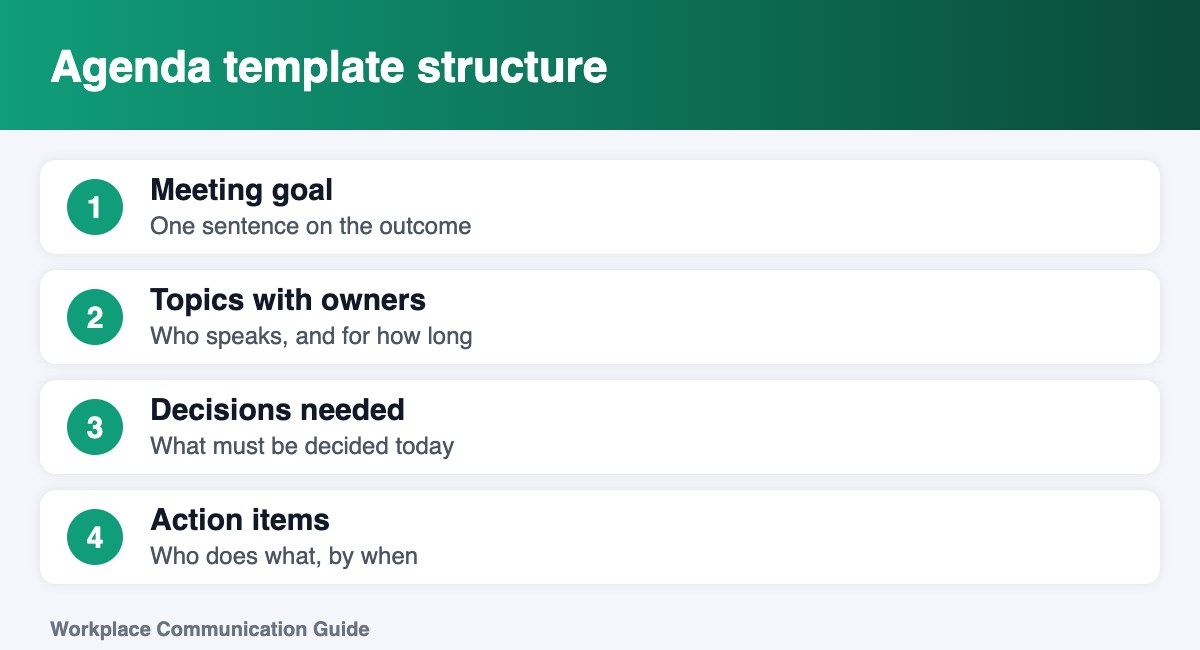
- Goal: one sentence describing the outcome, such as “Decide the launch date for the spring campaign.”
- Topics: each with an owner and a time limit.
- Decisions needed: list what the group must decide, not just discuss.
- Next steps: leave five minutes to assign owners and deadlines.
Agenda template you can copy
Meeting: Spring campaign planning
Date and time: Tuesday, 10:00-10:30
Goal: Agree on launch date and owners
1. Quick wins and news (5 min), Maria
2. Launch date options (10 min), Jordan
3. Budget and risks (10 min), Sam
4. Action items and owners (5 min), Maria
How to run the meeting from the agenda
- Send the agenda at least 24 hours before.
- Start on time and restate the goal.
- Assign a timekeeper and a note-taker.
- Park off-topic items in a “later” list.
- End with a recap of decisions and next steps.
After the meeting
Send notes the same day. Include decisions, owners and dates in bullets. A short follow-up message keeps momentum and prevents misunderstandings.
Subject: Notes: Spring campaign planning
Hi team,
Thanks for today’s meeting. Decisions: launch on March 4, budget capped at $8,000. Actions: Jordan will send the creative brief by Friday; Sam will confirm vendors by Monday.
Best,
Maria
Common agenda mistakes
- Too many topics for the time available.
- No owner for each item.
- Vague goals like “discuss marketing.”
- Never recording decisions.
- Inviting people who do not need to attend.
Frequently asked questions
How long should an agenda be?
One page at most. Aim for three to five topics for a 30-minute meeting.
Do I need an agenda for a one-on-one?
A shared running list of topics works well. Both people add items before the meeting.
What if the meeting runs over?
Decide at the start what is essential. Move low-priority topics to email or the next meeting.
For more ideas, see our meeting agenda examples and learn how to say no at work to unnecessary meetings.
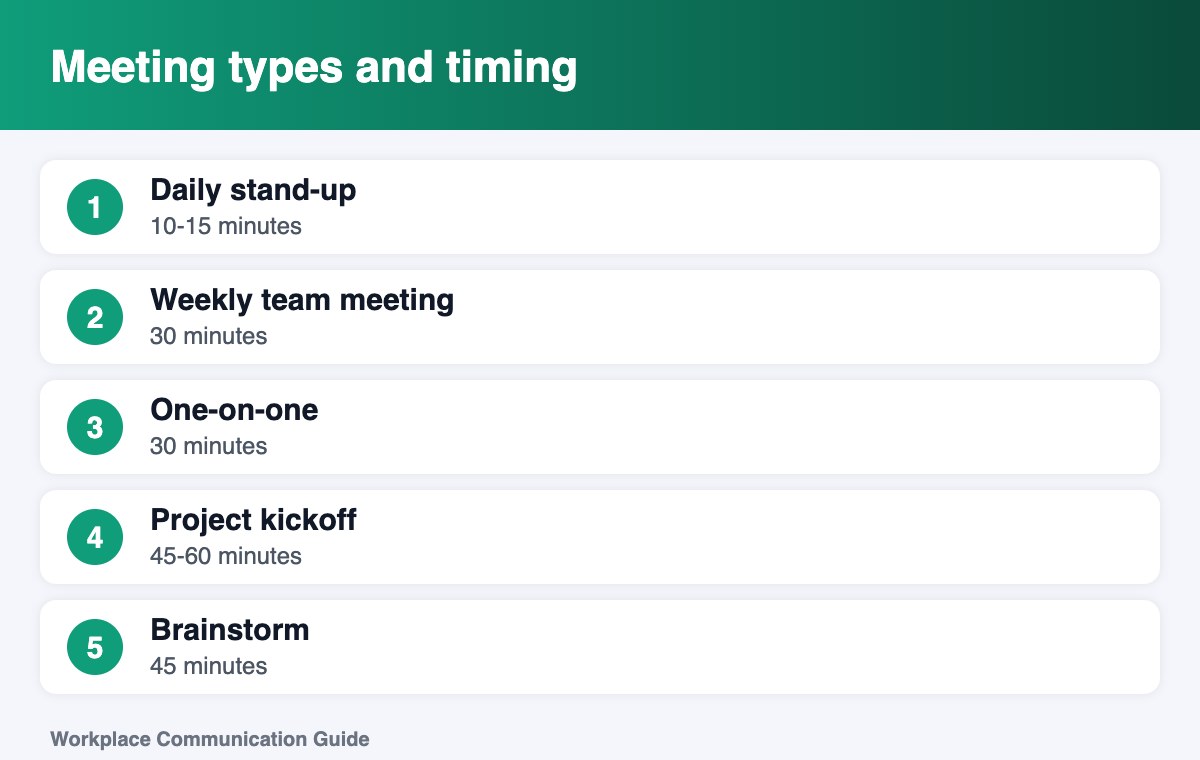
Agenda templates for different meeting types
Weekly team meeting
Start with wins, then updates by project, then blockers. Keep it to 30 minutes and move long discussions to a separate session.
One-on-one
Use a shared document with three sections: your topics, their topics and next steps. Rotate who goes first so both voices are heard.
Project kickoff
Cover the goal, scope, roles, timeline, risks and communication plan. End with each person stating what they will do first.
Brainstorm
Share the problem in advance, ask people to write ideas silently for five minutes, then discuss and vote. This avoids the loudest voice dominating.
Tools that help
You do not need special software. A shared document, a calendar invite with the agenda in the description and a simple task list are enough. If you use video calls, paste the agenda in the chat at the start so everyone can see it.
Hybrid and remote meeting tips
- Share the agenda and any documents before the call.
- Ask people to turn on cameras only if it helps the discussion.
- Use the chat for questions so the speaker is not interrupted.
- Record decisions in writing and share them within a day.
- Rotate meeting times if your team spans time zones.
A short checklist before every meeting
- Is a meeting really needed, or would an email or chat message work?
- Is the goal written in one sentence?
- Does each person invited have a role?
- Is the agenda shared at least a day ahead?
- Do you have a note-taker and timekeeper?
- Will the meeting end with owners and dates?
If you cannot answer yes to most of these, shorten the meeting, split it or replace it with a written update. Respecting people’s time is one of the quickest ways to build a reputation as a clear, reliable communicator.
