

“What is your greatest weakness?” makes many candidates freeze. In addition, interviewers do not ask it to trap you. They want to see self-awareness, honesty and a willingness to grow. Moreover, this guide shows you how to answer what is your greatest weakness with a simple formula, ten sample answers and the weaknesses you should never name.
You will also find tips for how to answer what is your greatest weakness when you are early in your career, changing fields or interviewing for a leadership role.
In this guide:
- Why interviewers ask this
- A 3-step formula
- 10 sample answers
- Weaknesses to avoid
- Tips for a strong answer
- FAQ
Why interviewers ask about your greatest weakness
This question tests three things: whether you know yourself, whether you can be honest under pressure and whether you work to improve. A thoughtful answer shows maturity. A rehearsed non-answer, such as “I am a perfectionist,” shows the opposite. Therefore, choose a real weakness that will not stop you from doing the job.
A 3-step formula for “what is your greatest weakness”
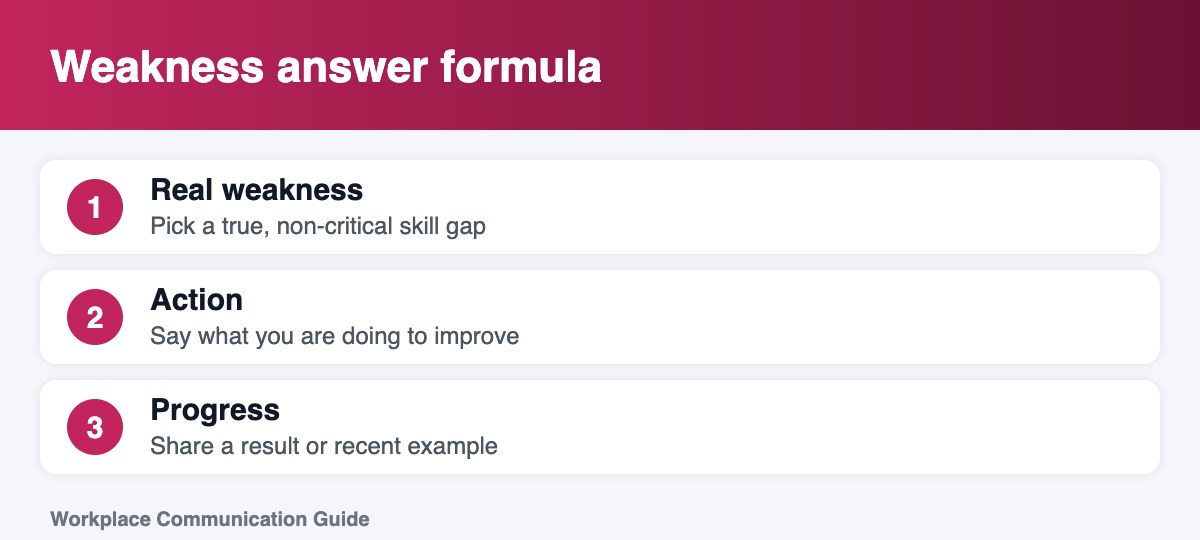
Greatest weakness answer example 1: choose a real, non-critical weakness
Pick something true that is not essential to the role. A bookkeeper should not say “I am bad with numbers.” Instead, look at the posting and choose a skill that is helpful but not central.
Greatest weakness answer example 2: show what you are doing about it
Describe one concrete step: a course, a tool, a mentor or a habit. Furthermore, this is the most important part of your answer.
Greatest weakness answer example 3: share progress
End with a result or recent example. Also, it proves the weakness is shrinking and leaves a positive final impression.
10 sample answers to “what is your greatest weakness”
Greatest weakness answer example 1: public speaking
“I used to get nervous presenting to large groups. I joined a local speaking club last year and now lead our monthly team update with confidence.”
Greatest weakness answer example 2: delegating
“I tend to take on too much myself. I now use a simple task board to hand off work, and my team has delivered two projects faster because of it.”
Greatest weakness answer example 3: saying no
“I used to say yes to every request. I have learned to check priorities first, and I now explain trade-offs clearly. Our guide to saying no at work covers this well.”
Greatest weakness answer example 4: technical skill gap
“I have limited experience with advanced spreadsheet formulas. I am taking an online course and already built a reporting dashboard for my team.”
Greatest weakness answer example 5: asking for help
“Early on I waited too long to ask questions. Now I set a 30-minute rule: if I am stuck that long, I ask a colleague.”
Greatest weakness answer example 6: receiving feedback
“I used to take criticism personally. I now ask for feedback regularly, and I treat it as data. This guide to asking your manager for feedback helped me.”
Greatest weakness answer example 7: too detail-focused
“I can spend too long on small details. I now set time limits for each task and check the big picture first.”
Greatest weakness answer example 8: early-career answer
“I have limited experience managing projects. I volunteered to coordinate a campus event with 40 people and learned to plan timelines and track tasks.”
Greatest weakness answer example 9: career changer
“I am new to this industry’s software. I have completed two tutorials and am practicing on a personal project every week.”
Greatest weakness answer example 10: leadership role
“I sometimes move quickly and forget to explain context. I now start each project with a short brief so everyone understands the goal.”
Weaknesses to avoid naming
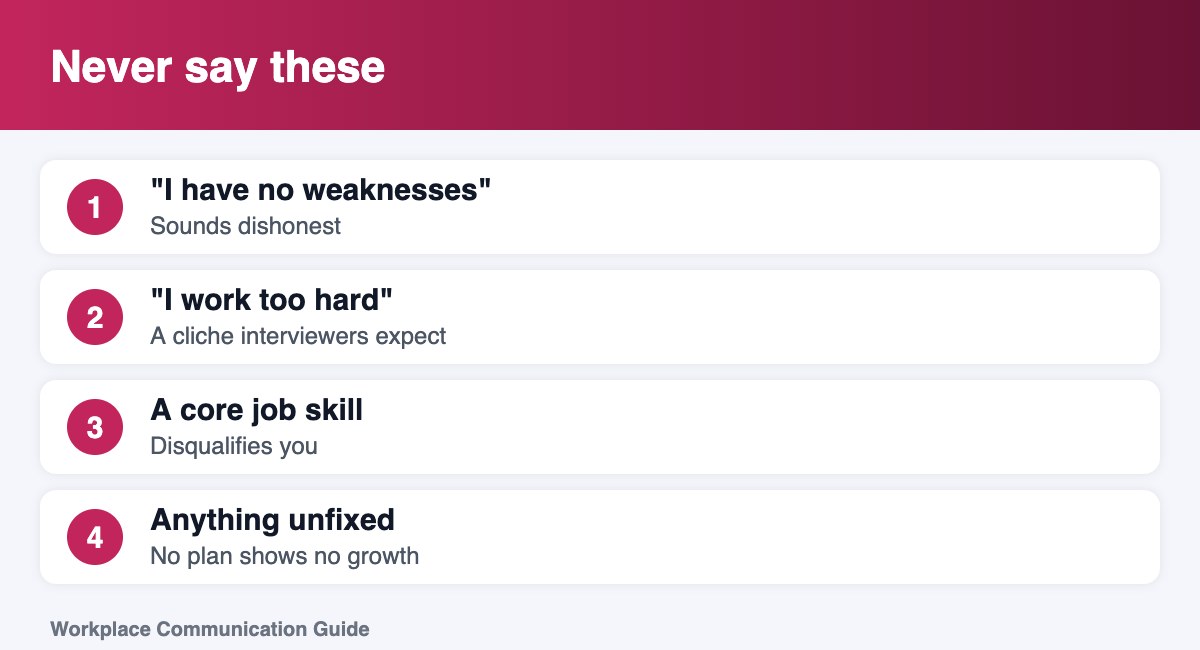
- A core requirement of the job. It can end your chances.
- Fake weaknesses. “I work too hard” sounds rehearsed.
- Personal character flaws. Avoid anything about honesty or reliability.
- No plan. A weakness without improvement shows no growth.
Tips for a strong answer
- Keep it under 60 seconds.
- Use one weakness only; do not list several.
- Practice out loud so it sounds natural.
- Match the weakness to the job description.
- Follow with a question to keep the conversation going.
Pair this with our guides to why should we hire you and tell me about yourself. The U.S. Department of Labor’s CareerOneStop interview tips are another free resource.
Frequently asked questions
How do I answer what is your greatest weakness with no experience?
Choose a skill you are still building, such as public speaking or project management, and describe the steps you are taking to improve.
Is it okay to say I do not have any weaknesses?
No. In addition, it sounds dishonest or unaware. Everyone has areas to improve.
How long should my answer be?
Aim for 45 to 60 seconds, with about half spent on how you are improving.
Should I ask about strengths too?
Be ready for both. Moreover, interviewers often ask for your strengths and weaknesses together.
What should I do after the interview?
Send a thank-you email after the interview within 24 hours.
To sum up, a strong answer to “what is your greatest weakness” is honest, specific and focused on growth. Furthermore, choose a real but non-critical weakness, explain your plan and share your progress. Practice it until it feels natural.
How to talk about weaknesses in different situations
The same weakness can need a different framing depending on the situation. Also, in a first-round phone screen, keep it short: name the weakness, add one improvement step and move on. In a final interview with a hiring manager, you can go deeper and share a story that shows how you learned.
If you are asked about strengths and weaknesses together
Many interviewers ask “What are your strengths and weaknesses?” in one question. In addition, start with two strengths that match the job, each backed by a short example. Then name one weakness using the formula above. Moreover, this balance shows confidence without arrogance.
If you freeze
It is perfectly fine to pause for a few seconds. Furthermore, say, “That is a great question, let me think for a moment.” A calm pause looks more professional than a rushed answer. You can also keep a short list of two or three prepared weaknesses in your notes so you never start from zero.
A final example you can adapt
“One area I have been working on is being concise in emails. I tended to write long messages, so I now start with the main point and keep each email under five sentences. My manager recently told me my updates are much easier to follow.”
Notice how this answer is honest, specific and ends with proof of progress. Also, use the same pattern with your own story.
