
You walked out of the interview, took a breath and thought you were finished. Also, you are not quite. A thank-you email after an interview is one of the simplest ways to stand out. In addition, it will not rescue a weak interview, but in a close decision between two strong candidates, it can tip the scales. It shows professionalism, gives you one more chance to connect your skills to the role and keeps your name in front of the hiring team.
Quick answer: Send a thank-you email within 24 hours of the interview. Keep it to three to five sentences, thank the interviewer by name, mention one specific topic you discussed and restate why you are a strong fit.
This guide explains when to send the email, what to include, and gives you templates for a one-on-one interview, a panel and a situation where you forgot to mention something. You will also see subject lines, real examples and mistakes to avoid.
Do you really need to send a thank-you email after an interview?
Yes. Moreover, many hiring managers say they notice who sends one and who does not. It signals that you are courteous, organized and interested in the job. Furthermore, for roles that involve communication, such as marketing, sales or customer support, it can also act as a small writing sample.
- It reinforces your fit. You can restate one reason you are a strong candidate.
- It fixes small gaps. You can add something you forgot to say.
- It keeps the conversation going. It sets up the next step without sounding pushy.
When to send a thank you email after interview
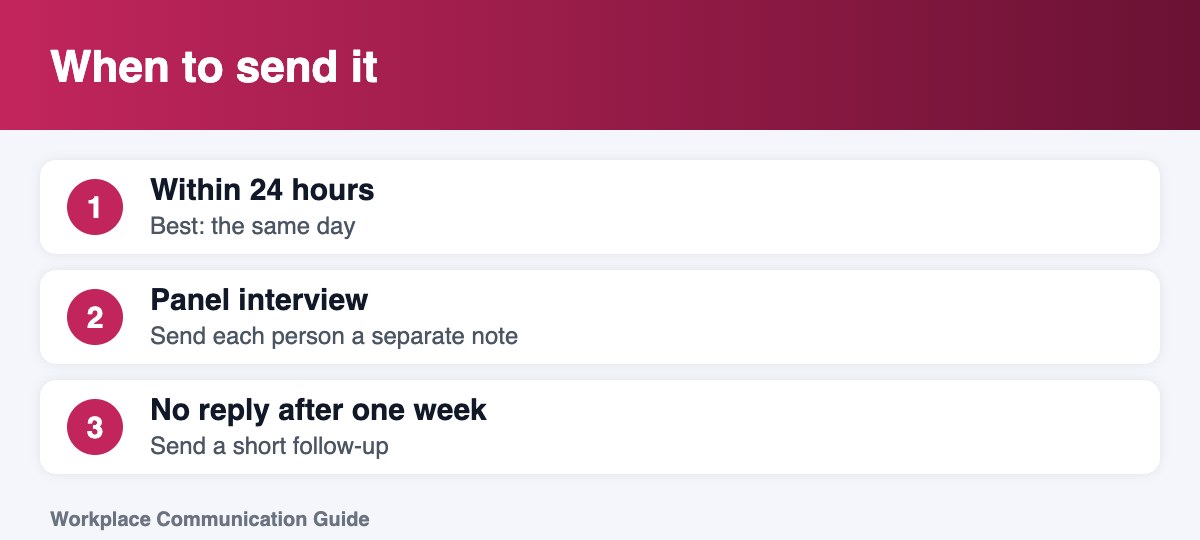
Send the email within 24 hours, and ideally on the same day while the conversation is fresh. If the hiring decision is expected quickly, send it within a couple of hours. If you interviewed with several people, write each person a separate note and change a sentence or two so they are not identical.
What to include in your thank-you email
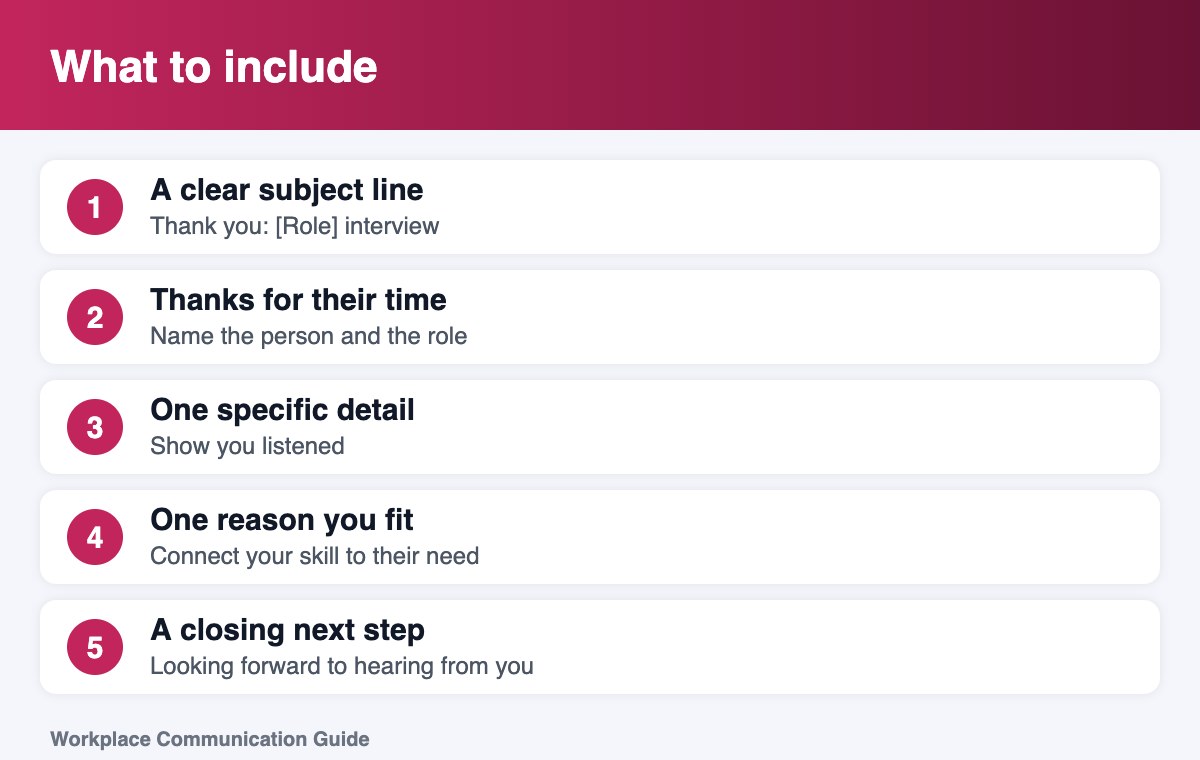
1. A clear subject line
Keep it simple: “Thank you: Marketing Coordinator interview” or “Thank you for your time today.”
2. A thank-you to the interviewer
Name the person and the role. “Thank you for speaking with me today about the Marketing Coordinator position.”
3. One specific detail from the conversation
This is the part that separates your email from a template. Mention a project, a challenge or a comment from the interview: “I enjoyed hearing about your plan to grow the spring newsletter.”
4. A reason you are a strong fit
Add one or two sentences that tie your experience to their need. “My experience growing a student newsletter from 400 to 2,100 subscribers would help with that goal.”
5. A polite close
End with a short line about next steps: “I look forward to hearing from you” or “Please let me know if I can provide anything else.”
Thank you email after interview templates
Standard one-on-one interview
Subject: Thank you: Marketing Coordinator interview
Hi Ms. Patel,
Thank you for speaking with me today about the Marketing Coordinator role. I enjoyed learning about your plans for the spring email campaign, and it reinforced how well my newsletter experience fits the team.
Please let me know if I can share anything else. I look forward to hearing about next steps.
Best,
Jordan Lee
Panel interview
Hello Ms. Patel and Mr. Rivera,
Thank you both for the thoughtful conversation today. Mr. Rivera, your point about measuring campaigns by reply rate rather than opens stayed with me, and I would be excited to bring that approach to the team.
Thank you again for your time.
Sincerely,
Jordan Lee
You forgot to mention something
Hi Ms. Patel,
Thank you again for your time. I realized I did not mention that I also manage our student group’s social calendar in Canva, which could help with your content workload. I would be glad to share examples.
Best,
Jordan
Phone or video interview
Subject: Thank you for the call today
Hi Mr. Rivera,
Thank you for taking the time to speak with me by video today. I appreciated learning how your team handles customer feedback, and I am confident my support experience would be a strong match.
I look forward to the next step.
Best regards,
Jordan Lee
Short version
Hi Ms. Patel,
Thank you for the conversation today. I am very interested in the role and excited about the chance to join your team.
Best,
Jordan
Thank-you email subject lines
- Thank you: [Role] interview
- Thank you for your time today
- Thanks for speaking with me today
- Following up: [Role] interview
- Thank you, [Name]
Thank you email after interview: common mistakes
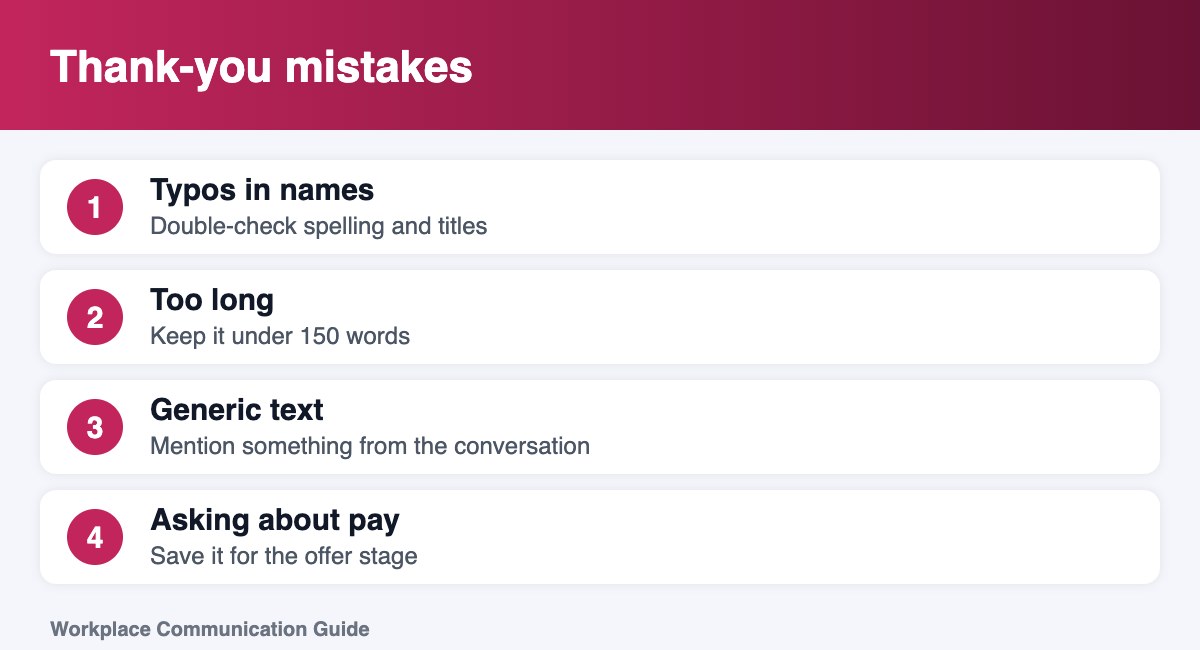
- Typos in names or titles. Confirm spelling from the email signature or company site.
- Long messages. Keep your note between 80 and 150 words.
- Copy-paste text. If you contact several people, tailor each note.
- Asking about salary. Wait until there is an offer.
- Waiting too long. After 48 hours, the value of the email drops.
What to do if you do not hear back
Wait until the timeline they gave you has passed. If they said “by the end of next week” and a week and a half goes by, send a short, polite message. Our guide to a follow-up email after no response has templates for exactly this.
Who to send it to and when
| Interview type | Send to | Timing |
|---|---|---|
| One-on-one | The interviewer | Within 24 hours |
| Panel interview | Each panelist separately | Within 24 hours |
| Phone screen | The recruiter | Same day or next morning |
| Final round | Hiring manager and recruiter | Within 24 hours |
Expert tips to make it memorable
- Reference a specific moment. A detail from the conversation proves you were listening.
- Write a different message for each person. Interviewers often compare notes.
- Proofread names and titles. A misspelled name can undo a good interview.
- Keep the subject line simple. “Thank you: Project Manager interview” works well.
- End with confidence. Say you look forward to the next steps rather than hoping to hear back.
Frequently asked questions
Is it too late to send a thank-you email after two days?
Not too late. Also, send it as soon as you can. A slightly late note is better than none.
Should I send a thank-you email if I think the interview went badly?
Yes. In addition, keep it short, polite and positive. You may also add a sentence that clarifies something you could have answered better.
Is a handwritten note better than an email?
Email is faster and fits most hiring timelines. A handwritten note can be an extra, not a replacement.
Should I send a thank-you to the recruiter as well?
Yes, a brief message to the recruiter or coordinator is a good idea, especially if they arranged the interview.
Can I connect on LinkedIn after sending the email?
Yes, but wait until after you send the thank-you note and keep the connection message short.
Related guides
Applying right now? Read our guide to a follow-up email after a job application, learn how to ask for a reference and practice with a simple formula for “tell me about yourself”.
Quick recap: send it within 24 hours, personalize one detail, restate one reason you fit, keep it under 150 words and proofread before you press send.
Thank you email after interview: a quick checklist
A thank you email after interview should take five minutes to write, but it can leave a lasting impression. First, send it within 24 hours. Next, mention one detail from the conversation. Then, connect your skills to the role in one sentence.
- Use the interviewer’s correct name and title.
- In addition, keep the email under 150 words.
- However, do not repeat your whole resume.
- Finally, proofread it twice before you press send.
To sum up, the best thank you email after interview is prompt, specific and short. Because hiring teams compare candidates carefully, this small step can help you stand out.
