

“Why should we hire you?” is one of the most common interview questions, and one of the most important. Also, hiring managers ask it to find out whether you understand the job, whether you can do it well and whether you will fit the team. If you know why should we hire you answers that are clear and specific, you can turn a nervous moment into your strongest one.
This guide gives you a simple formula, seven sample answers for different situations and the mistakes that cost candidates offers. In addition, read it once, adapt one answer to your own story and practice it out loud.
In this guide:
- What the interviewer really wants
- A 3-part formula
- 7 sample answers
- Mistakes to avoid
- How to practice
- FAQ
What the interviewer really wants when they ask why they should hire you
Behind this question are three smaller ones. First, can you do the work? Second, will you do it well and reliably? Third, will you add something the other candidates will not? Your answer should address all three in under a minute. Therefore, think about the job description before you think about yourself.
- Can you do it? Show that your skills match the top needs in the posting.
- Will you deliver? Give proof, such as a result with a number.
- Will you fit? Show that you understand the team and want this role specifically.
A simple 3-part formula for “why should we hire you”
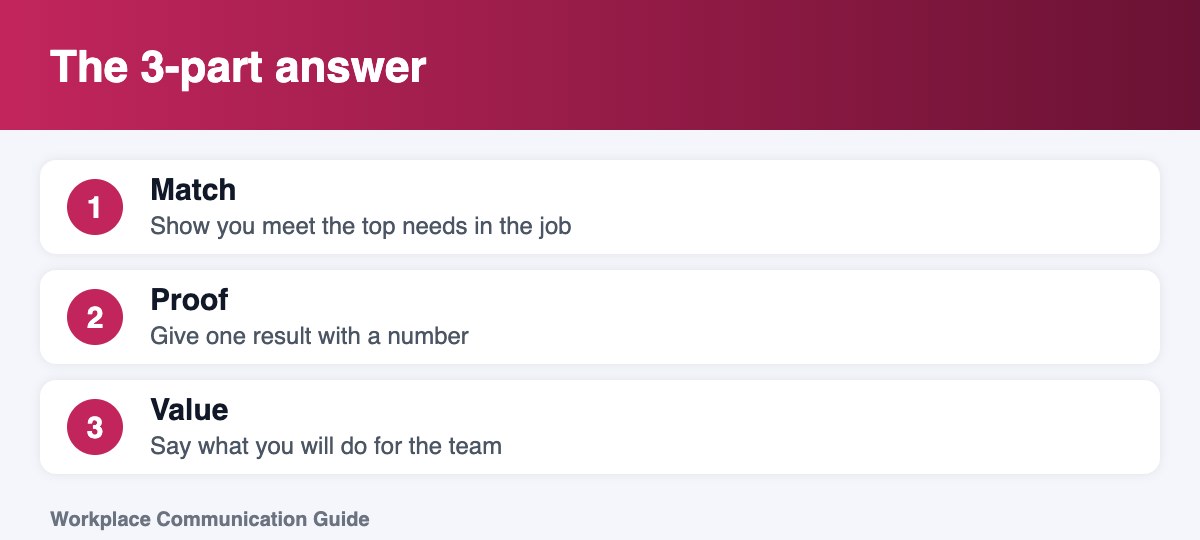
Why should we hire you example 1: match their needs
Read the posting and pick the two or three requirements that matter most. Then say you have them: “You are looking for someone who can manage client email campaigns, and that is what I do every day.”
Why should we hire you example 2: prove it with one result
Add one specific example with a number. “Last year I grew our newsletter from 400 to 2,100 subscribers, and open rates rose by 12 percent.” Because numbers are easy to remember, they make you stand out.
Why should we hire you example 3: say what you will add
Finish with the value you will bring: “I would bring that same focus on clear writing to your spring campaign.” This shows you are already thinking about the job.
7 sample answers to “why should we hire you”
Why should we hire you example 1: early-career candidate
“You need someone who can write clearly and learn fast. In my last role I ran our student newsletter, grew it from 400 to 2,100 subscribers and learned to use email analytics tools on my own. I would bring that energy and willingness to learn to your marketing team.”
Why should we hire you example 2: experienced professional
“With six years in customer support, I know how to calm a difficult conversation and fix the problem. I reduced our average resolution time by 20 percent by writing better templates. I would bring that same approach to your support team.”
Why should we hire you example 3: career changer
“I have spent five years in teaching, so I am used to explaining complex ideas simply and managing a room. I recently completed a certificate in digital marketing and ran two campaigns for a nonprofit. I would bring clear communication and strong organization to this role.”
Why should we hire you example 4: no direct experience
“I may not have held this exact title, but I have the skills you listed. I coordinated a 40-person event, managed a budget and wrote all the communications. I learn quickly, and I would work hard to get up to speed.”
Why should we hire you example 5: short answer for a phone screen
“I have three years of experience in the exact tools you use, I hit my targets every quarter and I enjoy working with small, fast-moving teams.”
Why should we hire you example 6: leadership role
“I have led teams of eight through two reorganizations, and our engagement scores rose each time. You need someone who can keep a team focused through change, and that is what I do best.”
Why should we hire you example 7: when you are the underdog
“Other candidates may have longer resumes, but I bring a strong record of results and real enthusiasm for your mission. I am ready to start contributing quickly and keep growing with the company.”
Mistakes to avoid when you answer why they should hire you
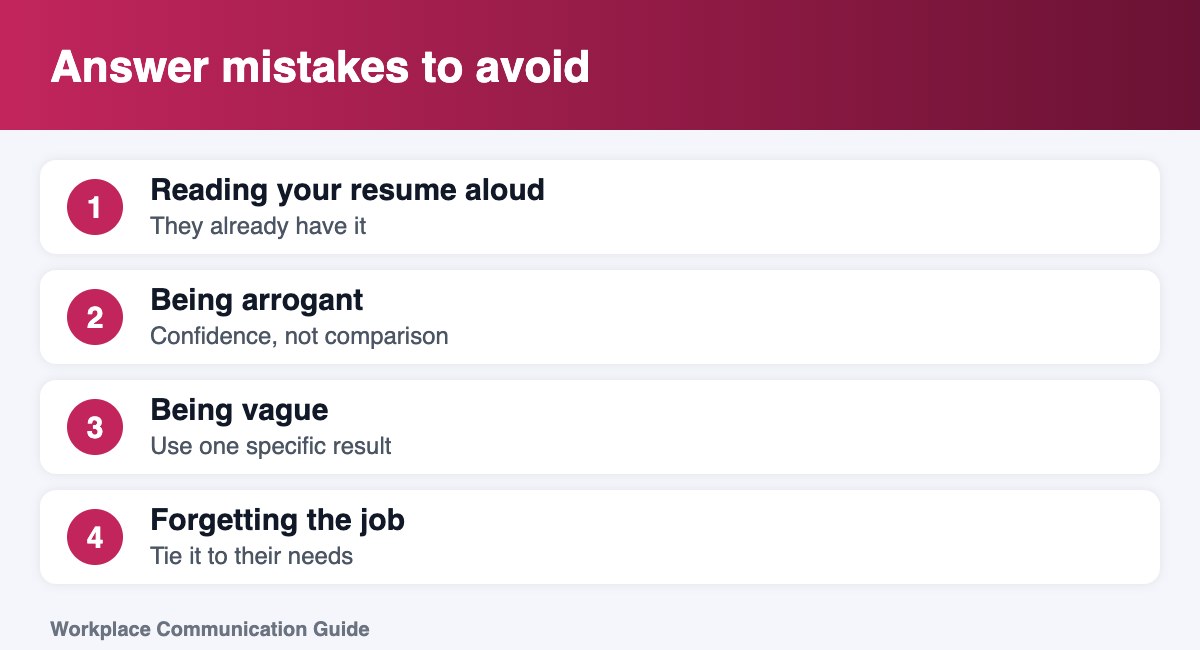
- Reading your resume aloud. Highlight what matters most instead.
- Comparing yourself to others. You do not know the other candidates, so focus on your strengths.
- Being vague. “I am a hard worker” says little. A result says much more.
- Ignoring the job. Tie every point to what the employer needs.
- Talking too long. Aim for 45 to 60 seconds.
How to practice your answer
- Highlight three requirements in the job description.
- Write one proof point for each.
- Say your answer out loud and time it.
- Record yourself and listen for filler words.
- Adjust the last sentence for each company.
For more preparation, read our guides to “tell me about yourself”, “what is your greatest weakness” and questions to ask the interviewer. The U.S. Department of Labor’s CareerOneStop interview tips are also a helpful, free reference.
Frequently asked questions
How long should my answer be?
About 45 to 60 seconds. Moreover, short enough to hold attention, long enough to include one proof point.
What if I have no experience?
Focus on transferable skills, projects, volunteering and your ability to learn. Furthermore, give one concrete example of each.
Should I mention other candidates?
No. Also, talk about your own strengths and fit.
Can I use the same answer for every job?
Use the same structure but change the details to match each posting.
Should I follow up after the interview?
Yes. In addition, send a thank-you email after the interview within 24 hours.
In summary, the best answer to “why should we hire you” is short, specific and tied to the job. Moreover, match their needs, prove it with one result and say what you will add, and you will leave a strong impression.
A quick checklist before your interview
Before you walk in, run through this short list. First, reread the job posting and underline the three skills it mentions most. Second, write one result for each skill, with a number if you can. Third, practice your answer out loud until it takes under a minute. Finally, prepare one sentence that explains why you want this company in particular. Employers can tell quickly when a candidate has done this homework.
It also helps to adapt your tone to the format. Furthermore, on a phone screen, keep the answer to three or four sentences. In a panel interview, make eye contact with everyone, not just the person who asked. Also, on a video call, look at the camera when you give your key point so it feels personal.
Example of a weak versus strong answer
A weak answer sounds like this: “I am hard-working and I really need this job.” It focuses on you and offers no evidence. A strong answer sounds like this: “You need someone to cut report turnaround time, and I reduced ours from five days to two last year. I would bring that same process to your team.” It is specific, relevant and confident.
