
You sent a thoughtful email and heard nothing. It is frustrating, but it is also normal. Most people are not ignoring you. They are busy, the message got buried, or they meant to reply and forgot. A polite follow-up email after no response is not pushy. In many cases it is the thing that gets you the answer.
Quick answer: Wait three to five business days, then send a short, polite follow-up that restates your request and makes it easy to reply. Send up to three follow-ups, spaced at least a week apart, and then move on.
This guide explains when to send a follow-up, how many to send, and gives you seven copy-ready templates for different situations, from a gentle nudge to a final message. You will also find rules for subject lines, tone and common mistakes.
Why people do not reply to emails
- Inbox overload. A typical professional receives dozens of emails a day, and yours may have scrolled out of view.
- No clear ask. If the reader cannot tell what you need, they delay.
- Bad timing. Travel, deadlines or meetings can push replies back by days.
- They need time to find the answer. Some questions require research.
- It was marked as read. Opening an email on a phone often means “I will answer later” and then forgetting.
Understanding this helps you follow up without frustration, which is the right tone for a successful reminder.
When to send a follow up email after no response
The right timing depends on urgency and the relationship. As a general rule for work emails:
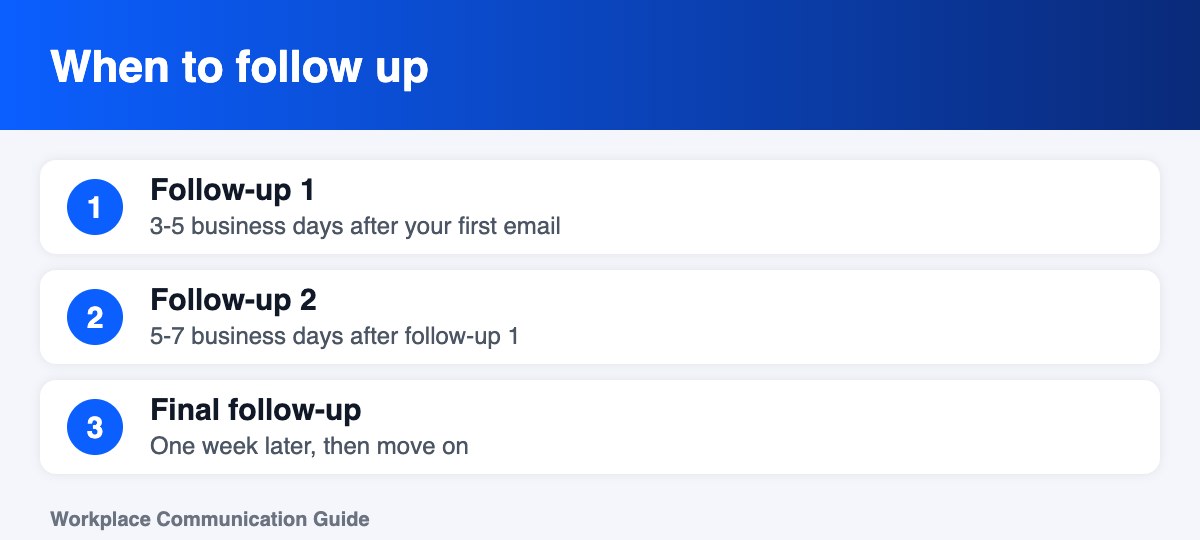
- Urgent requests: follow up after one business day and mention the deadline.
- Normal requests: wait three to five business days.
- Job applications and sales outreach: wait five to seven business days.
- Big asks or senior contacts: wait a week or more.
Avoid sending on Friday evenings or just before holidays, when inboxes pile up. Tuesday to Thursday mornings often work well.
How to write a follow up email after no response
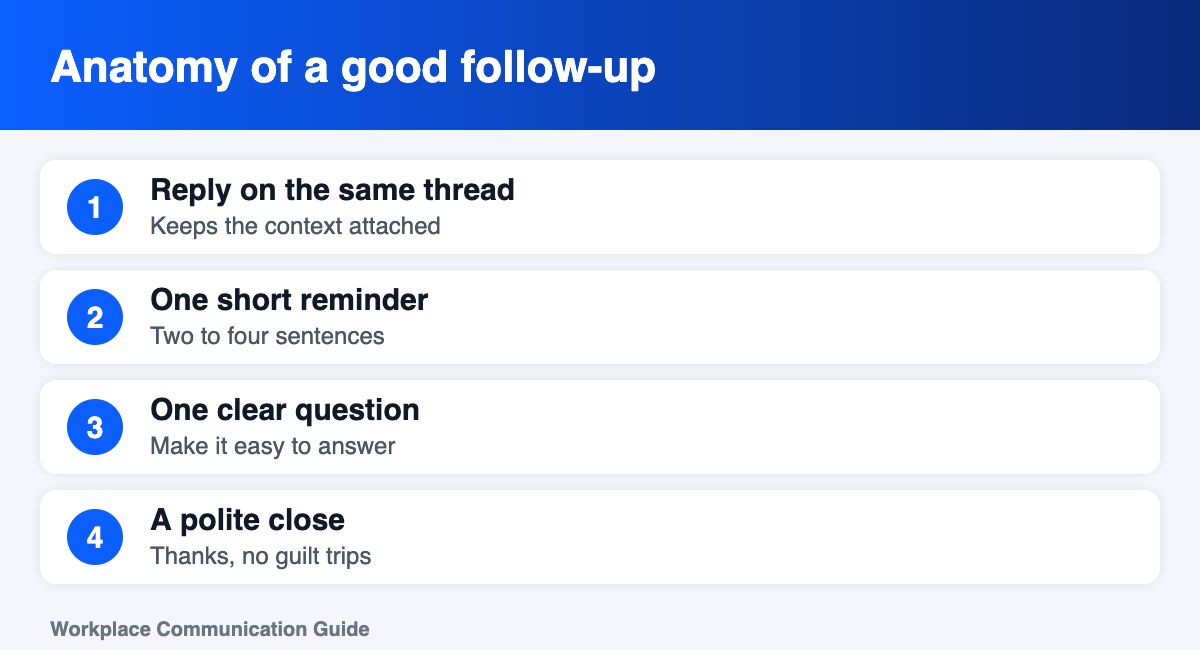
Reply on the same thread
Hit reply on your original message so the reader sees the full context. Keep the subject line the same and add “Following up” only if you want extra clarity, for example “Re: Question about the Q4 budget.”
Keep it short
Two to four sentences are enough. The goal is to remind, not to repeat your whole message.
Ask one clear question
Make it easy to reply with a yes, a no or a date. “Could you confirm by Friday?” is better than “Let me know what you think.”
Stay friendly
Assume the best. Avoid “As I said before” or “Per my last email.” Use a friendly phrase such as “I know things are busy.”
7 follow-up email templates you can copy
Template 1: The gentle nudge
Subject: Re: Question about the Q4 budget
Hi Maria,
I wanted to follow up on my note from Tuesday. Could you let me know by Friday if you have a moment to confirm the deadline?
Thanks,
Jordan
Use it when: it is your first follow-up and the request is routine.
Template 2: Add something useful
Hi Maria,
Following up on my earlier email. I also attached a one-page summary in case that is easier to review.
Thanks for your time,
Jordan
Use it when: you can make replying easier with a summary, draft or link.
Template 3: Make it a yes or no
Hi Maria,
Should I assume Thursday at 2 pm works for our call, or would another time be better? A quick yes or no is all I need.
Thanks,
Jordan
Use it when: you are scheduling and the reader may be too busy to write a full answer.
Template 4: Mention the deadline
Hi Maria,
I need to submit the final budget by Friday. If I do not hear back by Thursday, I will go ahead with the numbers I sent earlier. Please tell me if you would like any changes.
Thanks,
Jordan
Use it when: a decision is time-sensitive.
Template 5: Check you have the right person
Hi Maria,
I am not sure my last message reached the right person. Could you point me to who handles vendor approvals?
Thank you,
Jordan
Use it when: you suspect you wrote to the wrong contact.
Template 6: The final follow-up
Hi Maria,
I have not heard back, so I will assume this is not a priority right now and close it on my side. If it becomes relevant later, I would be glad to pick it up again.
Best,
Jordan
Use it when: you have sent two follow-ups and want to close the loop politely.
Template 7: Offer a quick call
Hi Maria,
I sent an email on Tuesday and wanted to make sure you saw it. If it is easier, I am happy to talk for five minutes this week.
Thanks,
Jordan
Use it when: the topic is complex and a short call might be faster than email.
Follow-up email subject lines
- Re: [original subject]
- Following up: [topic]
- Quick check on [project name]
- Checking in: [topic] by Friday
- One question about [topic]
Common follow up email mistakes after no response
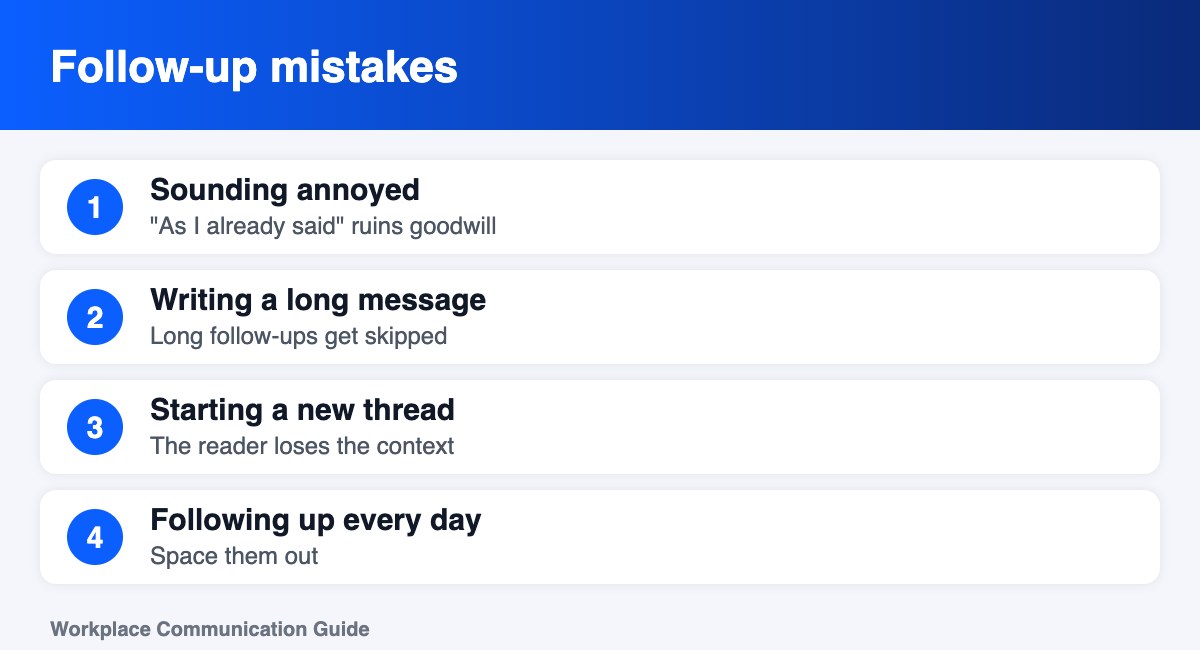
- Sounding frustrated. Tone travels badly in email.
- Writing too much. Long follow-ups feel like homework.
- Starting a new thread. The reader has to hunt for context.
- Following up too often. Daily nudges feel like pressure.
- Skipping the ask. A reminder without a clear question is easy to ignore.
What if there is still no reply?
After two or three follow-ups, change the channel. Send a short message on a workplace chat tool, ask a colleague who knows the person, or call if it is truly urgent. If the contact is external and the topic is not critical, close the loop and move on.
Follow up email after no response: schedule at a glance
| Follow-up | When to send | Goal |
|---|---|---|
| First | 3 to 5 business days after your email | Gentle reminder |
| Second | One week after the first | Add value or a new angle |
| Third | One week after the second | Close the loop politely |
| After that | Wait a month or change channel | Try a different contact |
Expert tips for a follow up email after no response
- Reply in the same thread. The original message gives the reader context at once.
- Make one clear ask. Emails with a single question are easier to answer.
- Keep it under 100 words. Short messages are read on phones and answered faster.
- Offer an easy next step. Try “Would Thursday at 2 pm work for a quick call?”
- Never guilt-trip. Phrases like “As I said before” push people away.
- Try another channel after three attempts. A short LinkedIn message or a call can reach someone who misses email.
Frequently asked questions about a follow up email after no response
How many times should I follow up?
Two or three times, spaced a week apart, is a good rule for most professional situations.
Is it rude to follow up?
No. A polite follow-up shows you are organized and interested. Being rude is the tone, not the follow-up itself.
Should I follow up by phone or email?
Start with email. Use a phone call or chat only when the issue is urgent or you already have that relationship.
What if my email went to spam?
That is possible. A follow-up with a different subject line or a short message on another channel can help.
Related guides
Looking for a job? Read our guide to a follow-up email after a job application and the thank-you email after an interview. To polish your messages, review how to end a professional email and professional email format.
Quick recap: wait a few days, reply on the same thread, keep it short, ask one clear question and stay friendly. Most replies come after the first or second follow-up.
Follow up email after no response: a quick checklist
Before you send a follow up email after no response, check the basics. First, confirm that you wrote to the right person. Second, make sure your original email had a clear question. Otherwise, the reader may not know what to answer.
- Wait the right number of days, as the timeline above shows.
- Reply on the same thread, because it keeps the context in one place.
- Ask one question, and make it easy to answer with a yes or a date.
- Finally, stay friendly, since tone matters more than speed.
In summary, a good follow up email after no response is short, kind and specific. Moreover, it gives the reader a simple next step. As a result, you get more replies and keep the relationship strong.
